Showing posts with label rainfall. Show all posts

Monday, 13 January 2014

Human intervention: help or hindrance?

http://www.wupr.org/2010/04/14/spin-till-you-win-chapter-2/20090831-climate-engineer/

In our rush to try to prevent severe climate change, scientists from the University of Reading have shown that one of the most credible methods, injecting reflective particles into the stratosphere, may have negative consequences for tropical rain forests.

The idea is that theses reflective particles should absorb and reflect incoming solar radiation, thus reducing that which reaches the planet and enters the greenhouse cycle inside our polluted atmosphere. The research team found that as well as absorbing heat coming in from the Sun, the particles also absorb some of the heat energy that comes from the surface of the planet. The heating this causes acts to stabilise this part of the atmosphere, but by making it more stable it reduces the upwelling of air in the  tropical overturning circulation. This then reduces the supply of warm moisture laden air that provides important rainfall, apparently reducing it by up to 30%.

However, others have questioned their findings, and the researchers admit that this was the most extreme model result in extreme warming scenarios. It seems that we can never know the true consequences of climate engineering until we try them for real. Have a read of the BBC report and the paper itself to find out more:

Matt McGrath, "Geoengineering plan could have 'unintended' side effect", http://www.bbc.co.uk/news/science-environment-25639343

Ferraro. A., J., E. J. Highwood and A. J. Charlton-Perez, (2014)"Weakened tropical circulation and reduced precipitation in response to geoengineering" Environmental Research Letters, 9, 1

Monday, 28 October 2013

Five Global Warming "Tipping Points"

This National Geographic article looks at 5 localities that are likely to change when we reach a tipping point relevant to that system, where crossing it would cause serious changes in some of Earth's system processes with knock-on effects on others. 
http://news.nationalgeographic.com/news/2009/03/photogalleries/tipping-points-climate-change/index.html 
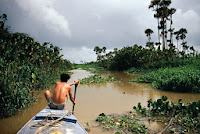
1) Amazon basin
Firstly, the Amazon Basin, where climate shifts may lead to less rainfall,huge loss of species diversity which would damage the forest's regulation of air quality, fresh water cycle, and atmospheric circulation.


Secondly, disruption on the Atlantic Meridional overturning circulation, preventing warm water from moving north and having a dramatic impact on ocean and terrestrial ecosystems, as well as affecting global climatic circulation.

Thirdly, a warming of 4 degrees C would cause massive melting of the Greenland ice sheet. An ice-free Greenland would cause up to 6 to 7 meters of sea-level rise, threatening up to 300 million people, as well as ecosystems, with harmful floods.


Fourth, some have suggested that the El Nino periodic shift in condition of the ocean and atmosphere in the tropical Pacific may become an almost permanent state, causing severe drought in Southeast Asia and the Amazon Basin and increased floods and changes in the marine food web along the South American Pacific coast.

Fifth, melting Antarctic ice could raise raise the world's sea level by up to 6 to 7 meters. The melting ice may reveal islands under the ice that are currently buried. Already fast moving ice streams have released large amounts of freshwater into surrounding oceans.