Showing posts with label climate change. Show all posts

Monday, 13 January 2014

Human intervention: help or hindrance?

http://www.wupr.org/2010/04/14/spin-till-you-win-chapter-2/20090831-climate-engineer/

In our rush to try to prevent severe climate change, scientists from the University of Reading have shown that one of the most credible methods, injecting reflective particles into the stratosphere, may have negative consequences for tropical rain forests.

The idea is that theses reflective particles should absorb and reflect incoming solar radiation, thus reducing that which reaches the planet and enters the greenhouse cycle inside our polluted atmosphere. The research team found that as well as absorbing heat coming in from the Sun, the particles also absorb some of the heat energy that comes from the surface of the planet. The heating this causes acts to stabilise this part of the atmosphere, but by making it more stable it reduces the upwelling of air in the  tropical overturning circulation. This then reduces the supply of warm moisture laden air that provides important rainfall, apparently reducing it by up to 30%.

However, others have questioned their findings, and the researchers admit that this was the most extreme model result in extreme warming scenarios. It seems that we can never know the true consequences of climate engineering until we try them for real. Have a read of the BBC report and the paper itself to find out more:

Matt McGrath, "Geoengineering plan could have 'unintended' side effect", http://www.bbc.co.uk/news/science-environment-25639343

Ferraro. A., J., E. J. Highwood and A. J. Charlton-Perez, (2014)"Weakened tropical circulation and reduced precipitation in response to geoengineering" Environmental Research Letters, 9, 1

Friday, 10 January 2014

What do tipping points mean to us?

As discussed in previous posts, tipping points are a concern for scientists and policy-makers due to the threat they pose to natural resources, ecosystem services and human well-being (Werners et al. 2013). Societies and economies across the globe are reliant on climate and ecosystem services in order for their current success, and also for that of future generations (Folke, C. 2006). Despite our dependence on natural resources, uncontrolled usage amongst other factors has depleted resources, whilst changing the composition of the atmosphere through emissions of greenhouse gases and enhancing global climate change. Climate change is only one of the challenges the global community faces today in terms of continuing development at a sustainable rate.

Werners et al. (2013) state that “climate change shifts the challenge for sustainability from preserving natural resources for future generations to strengthening resilience and adaptive capacity in social–ecological systems”. This means that policy making and resources management must change from a conservation basis to one that manages change and adaptation (Werners et al. 2013). Thresholds and tipping points, along with their properties and mechanisms, are important points for sustainability science, and their uncertainty is a big challenge when trying to remain sustainable.

Previous posts have mentioned that some systems have an indicator of change, if examined closely, which allows us either to mitigate against the changes or to prevent them from occurring where possible.  Biggs et al. (2009) found that if drivers of a system can only be manipulated gradually, action is needed much before a regime shift in order to prevent it, but if drivers can be rapidly altered, the action aversive action can be delayed until a shift is underway. However, these large, noticeable increases in the indicators only tend to occur once a regime shift has started, which is usually too late for human intervention to avert a shift (Biggs et al. 2009). Huntington et al. (2012) out into perspective the challenge we face and what it means for the average human:  “rapid sea level rise, for example from accelerated melting of the Greenland ice sheet, will create a choice between protection and abandonment for coastal regions throughout the world, a potential global tipping point” (Huntington et al. 2012).

Climate change is a challenge that most, if not all, governments cannot stretch to financially, and thus beyond a point, individuals must bear the costs or adapt to new circumstances, creating political-economic tipping points in countries everywhere (Huntington et al. 2012). The scale of the battle ahead depends largely on greenhouse gas emissions reductions, with temperature increase being a trigger for many of the fragile Earth systems responses. With many of the tipping points unknown, and the amplifying feedbacks and time-lag effects in systems underestimated (Werners et al. 2013), the challenge ahead is vast.

Biggs, R. S. R. Carpenter and W. A. Brock (2009) “Turning back from the brink: Detecting an impending regime shift in time to avert it” PNAS, 106, 3, 826–831
Folke, C.(2006) “Resilience: The emergence of a perspective for social–ecological systems analyses” Global Environmental Change 16, 253–267
Huntington, H.,P., E. Goodstein and E. Euskirchen (2012) “Towards a tipping point in responding to change: rising costs, fewer options for Arctic and global societies” Ambio. 41, 1, 66-74

Werners, S., E., S. Pfenninger, E. van Slobbe, M. Haasnoot, J. H Kwakkel and R. J. Swart, (2013) “Thresholds, tipping and turning points for sustainability under climate change” Current Opinion in Environmental Sustainability, 5, 334–340

Friday, 27 December 2013

Decline of the Mammals

There has been much debate about the cause of mass extinctions at the last major global climate upheaval: the Holocene glacial to interglacial transition (Lister and Stuart, 2008). Vegetational belts and mammalian communities underwent major reorganisation, with many large mammals becoming extinct, and causality arguments generally revolve around a joint cause of human and climate. Evidence of these extinctions can be found from palaeontology, climatology, archaeology and ecology, using radiocarbon dating to temporally place each piece of evidence (Barnosky et al. 2004). Barnosky et al. (2004) detail how there is strong evidence for human induced population shifts and extinctions, but that climate change also plays a significant if not dominant role in all or some of the scenarios.
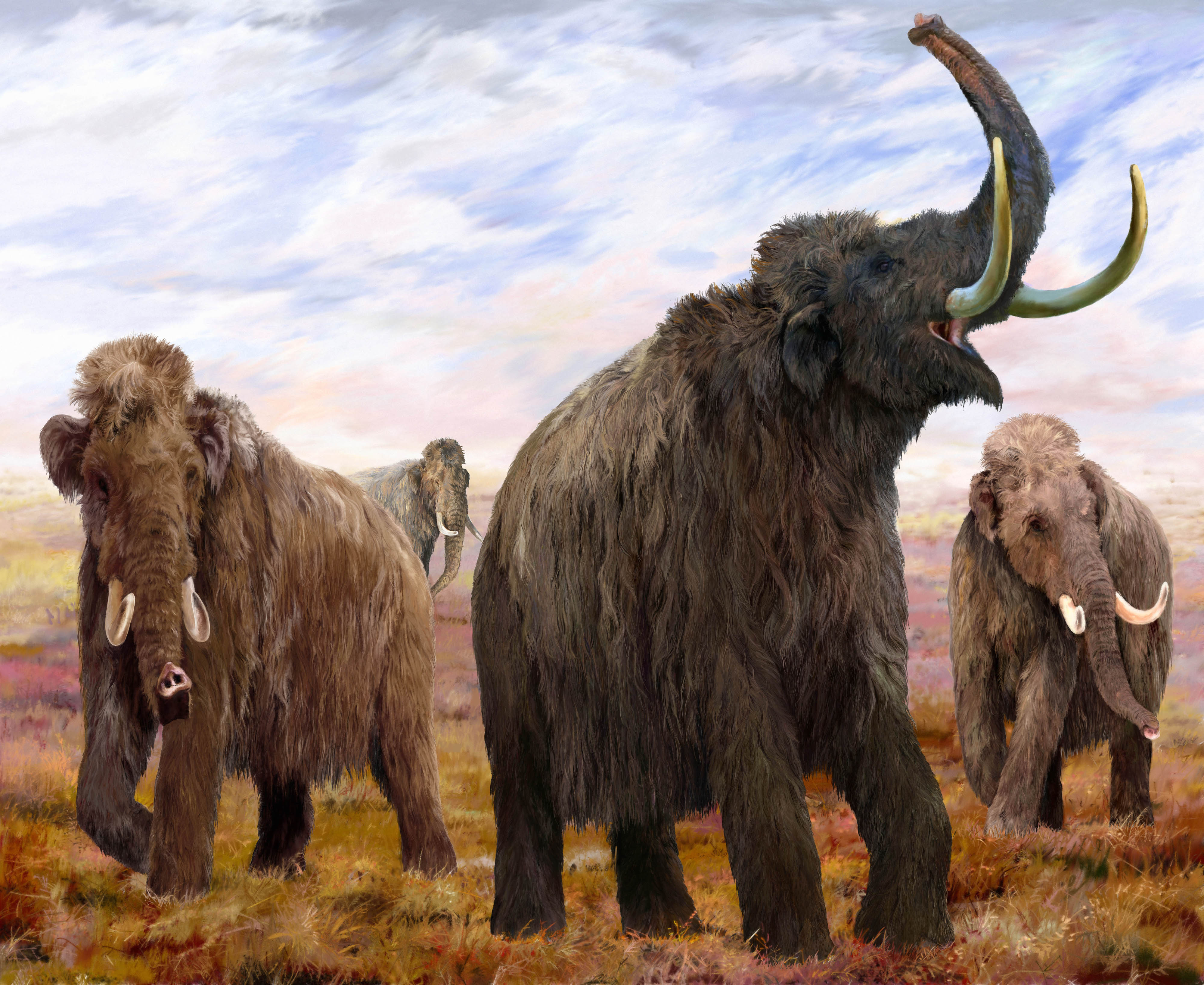
From: http://trueunknown.files.wordpress.com/2012/03/mammoths_wooly.jpg

The woolly mammoth (Mammuthus primigenius) is one of the better studied large mammals as an example of mass extinction. Sher (1997) proposed a ‘retreat to the north’ in Eurasia, where distribution of mammoths steadily contracted, until mammoth were restricted to Northern Siberia around 12 ka BP before finally becoming extinct. Stuart et al. (2002) researched further into this, and found this model to be fitting but to overlook the complexity of the pattern of extinction. They suggest, for example, absence and then re-colonization of the Russian Plain and even re-entry to Europe as the Fennoscandian ice sheet retreated (Stuart et al. 2002).
Lima-Ribeiro et al. (2013) studied two Proboscidean (mammoth) species in which they found a large contraction in the geographic range size: Cuvieronius hyodon and Notiomastodon platensis. Both were narrowly distributed on scattered patches habitat refugia around 11 ka, the period in which the earliest humans probably arrived in South America. Under the unsuitable climatic condition at this time, both Proboscideans would be extinct after about 550 years of human hunting, but if climatic conditions were suitable, like in Last Glacial Maximum (LGM), the time-for-extinction would be at least 3 times longer given the same human pressures (Lima-Ribeiro, 2013).

Cortell (2012), in his review of “Driven to Extinction: The Impact of Climate Change on Biodiversity” by Richard Pearson, makes the point that there is a huge amount of uncertainty when discussing climate change.  There is uncertainty in the impacts and extent of anthropogenic climate change, in the future trends in greenhouse gases, in the models we use to predict climate from these trends, and then uncertainties in the impacts of these changes on populations, species, and ecosystems, but that uncertainty should not become the key message (Cortell, 2012). The concluding paragraph of each paper encountered holds the same message: there is a need for more data before can we adequately attempt to answer the question of the cause or causes of extinction: climatic/environmental change or ‘overkill’ by human hunters (Stuart et al. 2002). This is despite many recent studies which have provided significant new finds and radiocarbon dating evidence, as well as other proxy indicators (Stuart et al. 2002), which will help to reduce uncertainty. These debates are ongoing, and it with more reading it becomes clear that the debate is not over choosing human or climate induced shifts, but in the amount of input that each of the factors had.

Barnosky, A., D., P. L. Koch, R. S. Feranec, S., L., Wing and A. B. Shabel (2004) “Assessing the causes of Late Pleistocene Extinctions on the Continents” Science, 306, 70, 70-75
Lima-Ribeiro, M., S., D. Nogués-Bravo, L. C. Terribile , P. Batra and J. A. F.  Diniz-Filho  (2013) “Climate and humans set the place and time of Proboscidean extinction in late Quaternary of South America” Palaeogeography, Palaeoclimatology, Palaeoecology, 392, 546–556
Lister, A., M., and A. J. Stuart (2008) “External Geophysics, Climate and Environment The impact of climate change on large mammal distribution and extinction: Evidence from the last glacial/interglacial transition” C. R. Geoscience 340, 615–620
Richard T. Corlett, (2012) "Climate-driven extinction, now and in the near future", Trends in Ecology and Evolution, 27, 8
Sher, A.V., 1997. "Late-Quaternary extinction of large mammals in northern Eurasia: a new look at the Siberian contribution". In: Huntley, B., Cramer, W., Morgan, A.V., Prentice, H.C., Allen, J.R.M. (Eds.), Past and Future Rapid Environmental Changes: the Spatial and Evolutionary Responses of Terrestrial Biota. Springer-Verlag, Berlin, Heidelberg, New York, pp. 319–339.
Stuart, A., J., L. D. Sulerzhitsky, L. A. Orlav, Y. V. Kuzmin and A. M. Lister, (2002) “The latest woolly mammoths (Mammuthus primigenius Blumenbach) in Europe and Asia: a review of the current evidence” Quaternary Science Reviews, 21, 1559–1569

Tuesday, 17 December 2013

Forests Fighting Climate

The rise of populations and technological and social development has driven up global demands for bio fuels and grain as feed for animals for meat. This creates powerful incentives for agro-industries to expand into forest regions, notably the Amazon rainforest, causing dramatic and often irreversible change to the environment (Nepstad et al. 2008). Forest fires, drought and logging increase susceptibility to further burning while deforestation and smoke can inhibit rainfall, exacerbating fire risk in this positive feedback loop. If sea surface temperature anomalies and associated droughts to continue, approximately 55% of the forests of the Amazon will be cleared, logged, damaged by drought or burned over the next 20 years, as shown in Figure 1 (Nepstad et al. 2008). The trees of the Amazon contain 90–140 billion tons of carbon, equivalent to approximately 9–14 decades of current global human-induced carbon emissions each year (Canadell et al. 2007). A lot of this is released back to the atmosphere, partly by a reduction in carbon uptake by the trees, but also in burning and soil process changes. Lenton et al. (2008) predict a timescale of 50 years for the Amazon to switch to an alternative state with severely decreased biodiversity and rainfall. A large fraction of precipitation in the Amazon basin is recycled, and reductions in precipitation lead to  lengthening of the dry season, and increases in summer temperatures that make it forest re-establishment difficult, and suggest the system may exhibit bi-stability, with two stable states (Lenton et al. 2008).
Figure 1 - Amazon forest degradation map (Nepstad et al., 2008)
It is also proposed that human induced climate change is impacting boreal forests, as shown by a study in the western United States that links forest “greenness” to fluctuating year-to-year snow-pack. This study showed that mid-elevation - those between approximately 6,500 to 8,000 feet - mountain ecosystems are most sensitive to rising temperatures and changes in precipitation and snow-melt (Trujillo et al, 2012). The study by University of Colorado, funded by NASA, used satellite and ground data to identify the threshold where mid-elevation forests sustained primarily by moisture shift into higher-elevation forests sustained primarily by sunlight and temperature. They found that  mid-elevation forests are very sensitive to snow that fell the previous winter, with about half of the mid-elevation forest greenness attributed to the previous winter’s snow accumulation (Trujillo et al, 2012). Climate studies indicate that snow-pack in mid-elevation forests in the Western United States and in similar forests around the world has been decreasing in the past 50 years due to regional warming (Trujillo et al., 2012), producing a feedback system that will continue to increase warming due to decreased albedo and reduced carbon sequestration. Lenton et al. (2008) predict that the decline of boreal forest would cause a biome switch on a scale of about 50 years, transitioning to open woodlands or grasslands. Under climate change the complex interaction between tree physiology, permafrost, and fire would experience increased water stress, increased peak summer heat stress causing increased mortality, vulnerability to disease and subsequent fire, as well as decreased reproduction rates (Lenton et al., 2008)


Nepstad et al (2008) conclude that trends in Amazon economies, forests and climate may lead to the replacement or severe degradation of more than half of the Amazon basin forests by 2030. They suggest that recent success in changing landholder behaviour, as well as the designation of protected areas and practical techniques for concentrating livestock production on smaller areas of land that could reduce the likelihood of severe environmental change.

Canadell, J. G. et al. (2007) “Contributions to accelerating atmospheric CO2 growth from economic activity, carbon intensity, and efficiency of natural sinks”. Proc. Nat. Acad. Sci. USA 104, 18 866–18 870.
Lenton, T., M., H. Held, E. Kriegler, J. W. Hall, W. Lucht, S. Rahmstorf, and H. J. Schellnhuber, (2008) “Tipping elements in the Earth’s climate system” PNAS, 105, 6, 1786–1793
Nepstad, D., C., C. M. Stickler, B. Soares-Filho, and F. Merry. (2008) Interactions among Amazon land use, forests and climate: prospects for a near-term forest tipping point. Phil. Trans. R. Soc. B 363, 1737–1746
Trujillo, E., N. P. Molotch, M. L. Goulden, A. E. Kelly and R.C. Bales (2012) “Elevation-dependent influence of snow accumulation on forest greening” Nature Geoscience, 5, 705–709

Friday, 25 October 2013

Planetary Boundaries and Tipping Points explained!

If you do any reading about "tipping points" you'll be bombarded with things like 'planetary boundaries', 'regime shifts', 'critical transitions' and just about every combination of these words. It can be a bit confusing! So I'm going to explain it in what I hope is a much clearer way....

Brook et al. (2013) describe the following:
· Planetary boundary: a concept developed to define a desired operating range for Earth-system features and processes. Crossing a boundary implies damage or loss of existing functions or services across the system.

· Regime shift: a large, relatively rapid reorganization of the state of an ecosystem that can be triggered by synergistic feedbacks. Regime shifts can result from crossing tipping points, and are often hard to anticipate and difficult to reverse.
· Tipping point: the critical point at which strong non-linearities appear in the relationship between ecosystem attributes and drivers; once a tipping point threshold is crossed, the change to a new state is typically rapid and might be irreversible or exhibit hysteresis.

Life on Earth has displayed abrupt and massive changes in the past, so we have no reason to expect that similar global regime shifts will not occur again. These shifts changed ecosystem dynamics worldwide by rising temperatures, changes in rainfall, retreat of polar ice and glaciers, and declining ocean pH amongst others, resulting in profound changes in ecosystem services, biodiversity, and aesthetic values. (Hughes et al. 2013). 

The problem is, not all these planetary boundaries and tipping points have been defined, and crossing these thresholds is unlikely to manifest as sudden and simultaneous collapses worldwide.What if we've already passed unrecognized and unanticipated tipping points as incremental changes accumulate, and are in a slow transition to a new regime? Once a transition occurs, it can be difficult or even impossible to return to the previous state (Barnosky et al, 2012).
This image from Barnosky et al (2012) shows a prediction of Earth ecosystem response as human population grows as does its impact on the environment. Here, the system crosses a tipping point and reaching an alternative stable state.

Human forcing includes transformation of 43% of land to agricultural or urban landscapes, with the remainder of natural landscapes broken up by roads. Even during the last global-scale critical transition, only 30% of Earth’s surface went from being covered by glacial ice to being ice free! Modelling suggests that for a third of Earth, plant species will not be able to migrate quick enough to keep up with climate change, and those that can will have to battle highly fragmented landscapes (Barnosky et al. 2012).


The scientific concept and potential policy implications of tipping points and their consequences have recently attracted considerable interest (Brook et al, 2013) and rightly so. Looking at past global-scale state shifts and the global forcings we continue to exert, suggests that another global-scale state shift is isn't far away, if it has not already begun (Barnosky et al, 2012). The extent and scale of human–biosphere interactions and disruption highlights the need to operate within safe planetary boundaries say Hughes et al, (2013). Regardless, we must address causes of human-driven global change and improve our management of the environment in order to prevent a global-scale state shift, or at least to monitor it as much as possible.

  • Barnosky, A., D., Et Al. (2012) “Approaching a state shift in Earth’s Biosphere” Nature, 486, 52-58
  • Brook, B.W. et al. (2013) Does the terrestrial biosphere have planetary tipping points? Trends Ecol. Evol. 28, 396–401
  • Hughes, T., P., S. Carpenter, J. Rockstrom, M. Scheffer, and B. Walker (2013) “Multiscale regime shifts and planetary boundaries” Trends in Ecology & Evolution , 28, 7