Showing posts with label atmosphere. Show all posts

Wednesday, 13 November 2013

Overview of IPCC 2013, Chapter 12 - Long-term Climate Change: Projections, Commitments and Irreversibility

Previously, the IPCC have been hesitant to use the term “tipping point”, possibly in reluctance to cause mass hysteria amongst the Daily Mail and similar. Even their most recent report doesn't feature tipping points strongly, though closer inspection reveals more. Their 2013 report details combined evidence from many of the best respected climate scientists to show that tipping points, or at least alternative stable states, do exist in a variety of forms, a few of which are discussed here.

The September 2013 report defines a tipping point as “a perturbed state irreversible on a given timescale if the recovery timescale from this state due to natural processes is significantly longer than the time it takes for the system to reach this perturbed state.” The Earth system has multiple and varied response timescales to climate changes. For a rapid change in forcing, much of the surface temperature response will be evident within decades. Taking that view, most aspects of the climate change resulting from CO2 emissions are irreversible due to the long residence time of CO2 in the atmosphere and the resulting warming (Solomon et al., 2009).

A number of components of Earth’s system have been proposed as possessing critical thresholds or tipping points, beyond which abrupt transitions to an alternative state result. It is important to note that abrupt changes that arise from nonlinearities within the climate system are intrinsically difficult to assess and timing of future changes difficult to predict, making mitigation difficult. This table shows some of the potential climate tipping points identified by the IPCC report.
 ARCTIC OCEAN
There is very little evidence in climate models of a tipping point from perennially ice-covered Arctic ocean to a seasonally ice-free Ocean where further ice loss in unstoppable. It is, however, very likely that Arctic sea ice will continue shrinking and thinning during the 21st century as global mean surface temperature rises. Conversely, it has been suggested by models that the surface mass balance of the Antarctic Ice Sheet may increase because increased snowfall rates outweigh melt increase. These abrupt changes in ice volume do not necessarily require the existence of a tipping point in the system. Irreversibility of ice sheet volume and extent changes can occur when a decreased elevation of the ice sheet induces a decreased surface mass balance, generally through increased melting.

ATLANTIC MERIDIONAL OVERTURNING CIRCULATION
Observations and models suggest that the present day ocean is already in a bi-stable regime, thereby allowing for multiple equilibria and a stable ‘off’ state of the Atlantic MOC (Bryden et al., 2011; Hawkins et al., 2011). It is very likely that the AMOC will weaken, but confidence in the magnitude of this is low, and crossing a tipping point similar to that of the Younger Dryas cooling is very unlikely in the next century or so.

INDIAN MONSOON
Studies with conceptual models (Zickfeld et al., 2005; Levermann et al., 2009) show that the Indian summer monsoon can operate in two stable regimes. Besides the “wet” summer monsoon, there is a stable state characterized by low precipitation over India. This suggests that any perturbation of the radiative budget that often weakens the pressure gradient could induce abrupt transitions between these two regimes.

So, there it is, there’s no denying that tipping points exist. The main point to take from this is that these changes are unpredictable in scale and in feedback response, and that most of the bigger climatic changes are unlikely to happen in the near future.


CLIMATE CHANGE 2013: THE PHYSICAL SCIENCEBASIS, Chapter 12, IPCC, 2013.  See full article for internal  references.)

Monday, 28 October 2013

Five Global Warming "Tipping Points"

This National Geographic article looks at 5 localities that are likely to change when we reach a tipping point relevant to that system, where crossing it would cause serious changes in some of Earth's system processes with knock-on effects on others. 
http://news.nationalgeographic.com/news/2009/03/photogalleries/tipping-points-climate-change/index.html 
1) Amazon basin
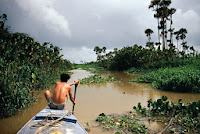
Firstly, the Amazon Basin, where climate shifts may lead to less rainfall,huge loss of species diversity which would damage the forest's regulation of air quality, fresh water cycle, and atmospheric circulation.


Secondly, disruption on the Atlantic Meridional overturning circulation, preventing warm water from moving north and having a dramatic impact on ocean and terrestrial ecosystems, as well as affecting global climatic circulation.

Thirdly, a warming of 4 degrees C would cause massive melting of the Greenland ice sheet. An ice-free Greenland would cause up to 6 to 7 meters of sea-level rise, threatening up to 300 million people, as well as ecosystems, with harmful floods.


Fourth, some have suggested that the El Nino periodic shift in condition of the ocean and atmosphere in the tropical Pacific may become an almost permanent state, causing severe drought in Southeast Asia and the Amazon Basin and increased floods and changes in the marine food web along the South American Pacific coast.

Fifth, melting Antarctic ice could raise raise the world's sea level by up to 6 to 7 meters. The melting ice may reveal islands under the ice that are currently buried. Already fast moving ice streams have released large amounts of freshwater into surrounding oceans.

Thursday, 17 October 2013

James Hansen - speaking truth to power

James Hansen: activist, environmentalist, physicist, astronomer, scientist. Whichever of these you choose, he’s a man recognized for “speaking truth to power”, that truly cares about Earth’s climate. His extensive work on climate research and on educating governments and public alike has raised awareness of global climate change significantly in the last 30 years.


For his TED talk in 2012, “James Hansen: Why I must speak out about climate change”, we see your average American man humbly and wholeheartedly addressing his audience.  He’s of mid-height, greying, and wearing the same hat as the day he was arrested for protesting outside the White House, but then again “What would you do if you knew what I (Hansen) know?”.


 He started his early work with Professor Van Allen, moving to NASA on a project studying Venus’s climate. It was during this project that Hansen turned this knowledge to Earth, truly adopting NASA’s mission statement: “TO UNDERSTAND AND PROTECT THE HOME PLANET” (a sentence quietly removed in 2006). He made calculations of the greenhouse effect and its predicted impact as atmospheric composition persistently changed.  His groundbreaking 1981 paper in Science magazine, observed warming of 0.4°C consistent with CO2 increase. They predicted that warming would exceed noise level of random weather by 21st C, causing shifting climate zones, drought and flood prone areas, rising sea levels, erosion of ice sheets, opening of the North West Passage…all of which are well underway. Following this paper, Hansen testified to congress, emphasizing increase in climate extremes around globe, with stronger extreme events 3sd or more above the norm. The paper stated “CO2 effects on climate may make full exploitation of coal resources undesirable”, a statement ignored by the Presidents climate task force, with which Hansen spoke twice.


Throughout the TEDtalk, Hansen makes the alarming science easy to understand...“The extra energy earth gains each day is 20x the energy used by all of humanity, its 400 000 Hiroshima bombs per day, all year”, and (especially for the Americans) “A warmer ocean releases CO2, just as a warm Coca-Cola does.”


The upper half of ocean is gaining heat at substantial rate, with the deep ocean not far behind and land warming to 10’s meters depth. This path guarantees that we will pass tipping points – ice sheet disintegration, 15-20% species committed to extinction by 2100, increasing floods and drought intensity leading to famine and global economic decline, and the longer we wait, the more difficult and expensive it becomes to prevent and reduce this.


The science is clear, Hansen concludes, with a plea to all “Clearly I haven’t gotten this message across. I need your help. We owe it to our children and grandchildren”. 


Have a listen yourself, if you weren't convinced on the severity of climate change already, this talk might provide your tipping point.