Showing posts with label extinction. Show all posts

Friday, 27 December 2013

Decline of the Mammals

There has been much debate about the cause of mass extinctions at the last major global climate upheaval: the Holocene glacial to interglacial transition (Lister and Stuart, 2008). Vegetational belts and mammalian communities underwent major reorganisation, with many large mammals becoming extinct, and causality arguments generally revolve around a joint cause of human and climate. Evidence of these extinctions can be found from palaeontology, climatology, archaeology and ecology, using radiocarbon dating to temporally place each piece of evidence (Barnosky et al. 2004). Barnosky et al. (2004) detail how there is strong evidence for human induced population shifts and extinctions, but that climate change also plays a significant if not dominant role in all or some of the scenarios.
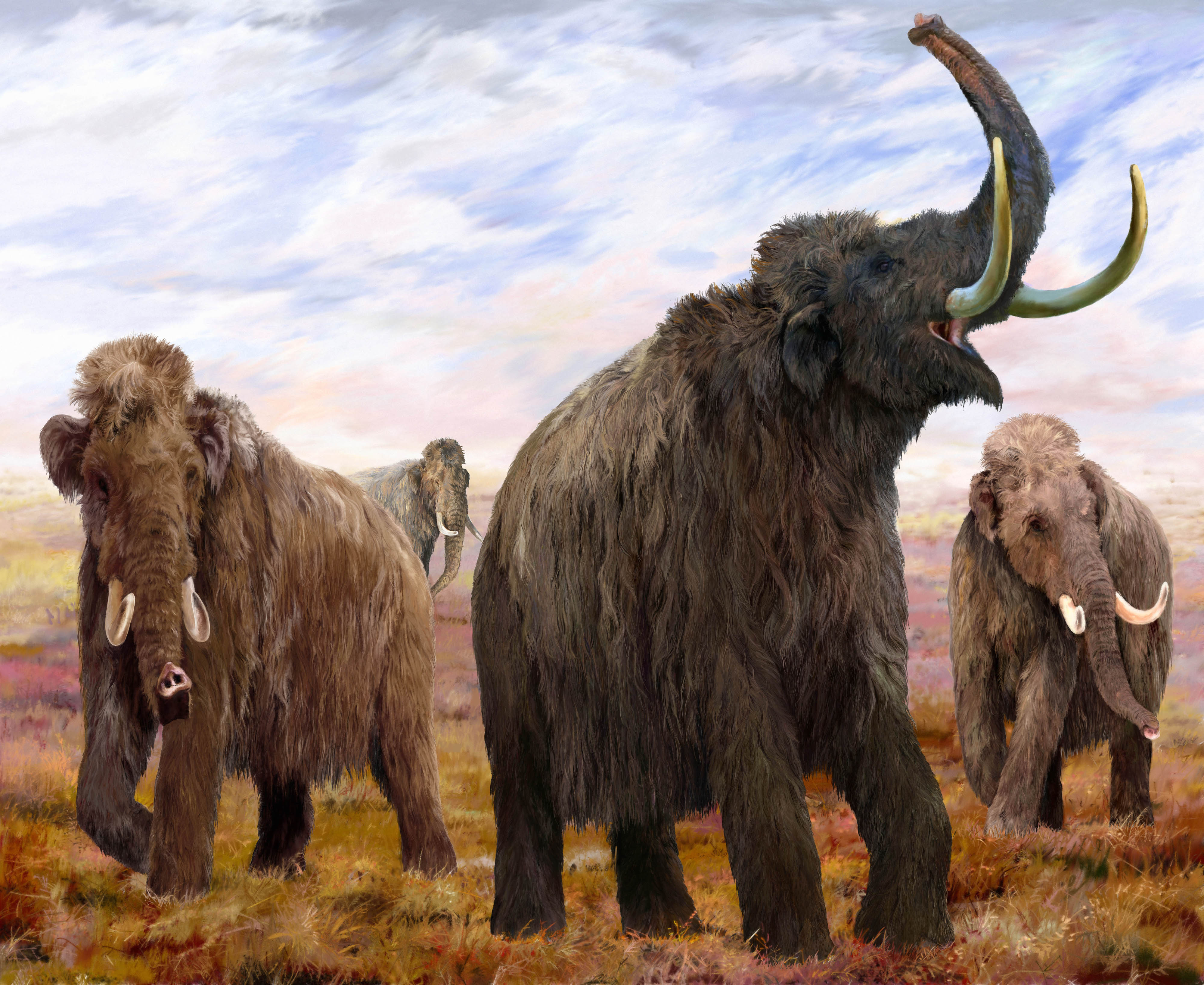
From: http://trueunknown.files.wordpress.com/2012/03/mammoths_wooly.jpg

The woolly mammoth (Mammuthus primigenius) is one of the better studied large mammals as an example of mass extinction. Sher (1997) proposed a ‘retreat to the north’ in Eurasia, where distribution of mammoths steadily contracted, until mammoth were restricted to Northern Siberia around 12 ka BP before finally becoming extinct. Stuart et al. (2002) researched further into this, and found this model to be fitting but to overlook the complexity of the pattern of extinction. They suggest, for example, absence and then re-colonization of the Russian Plain and even re-entry to Europe as the Fennoscandian ice sheet retreated (Stuart et al. 2002).
Lima-Ribeiro et al. (2013) studied two Proboscidean (mammoth) species in which they found a large contraction in the geographic range size: Cuvieronius hyodon and Notiomastodon platensis. Both were narrowly distributed on scattered patches habitat refugia around 11 ka, the period in which the earliest humans probably arrived in South America. Under the unsuitable climatic condition at this time, both Proboscideans would be extinct after about 550 years of human hunting, but if climatic conditions were suitable, like in Last Glacial Maximum (LGM), the time-for-extinction would be at least 3 times longer given the same human pressures (Lima-Ribeiro, 2013).

Cortell (2012), in his review of “Driven to Extinction: The Impact of Climate Change on Biodiversity” by Richard Pearson, makes the point that there is a huge amount of uncertainty when discussing climate change.  There is uncertainty in the impacts and extent of anthropogenic climate change, in the future trends in greenhouse gases, in the models we use to predict climate from these trends, and then uncertainties in the impacts of these changes on populations, species, and ecosystems, but that uncertainty should not become the key message (Cortell, 2012). The concluding paragraph of each paper encountered holds the same message: there is a need for more data before can we adequately attempt to answer the question of the cause or causes of extinction: climatic/environmental change or ‘overkill’ by human hunters (Stuart et al. 2002). This is despite many recent studies which have provided significant new finds and radiocarbon dating evidence, as well as other proxy indicators (Stuart et al. 2002), which will help to reduce uncertainty. These debates are ongoing, and it with more reading it becomes clear that the debate is not over choosing human or climate induced shifts, but in the amount of input that each of the factors had.

Barnosky, A., D., P. L. Koch, R. S. Feranec, S., L., Wing and A. B. Shabel (2004) “Assessing the causes of Late Pleistocene Extinctions on the Continents” Science, 306, 70, 70-75
Lima-Ribeiro, M., S., D. Nogués-Bravo, L. C. Terribile , P. Batra and J. A. F.  Diniz-Filho  (2013) “Climate and humans set the place and time of Proboscidean extinction in late Quaternary of South America” Palaeogeography, Palaeoclimatology, Palaeoecology, 392, 546–556
Lister, A., M., and A. J. Stuart (2008) “External Geophysics, Climate and Environment The impact of climate change on large mammal distribution and extinction: Evidence from the last glacial/interglacial transition” C. R. Geoscience 340, 615–620
Richard T. Corlett, (2012) "Climate-driven extinction, now and in the near future", Trends in Ecology and Evolution, 27, 8
Sher, A.V., 1997. "Late-Quaternary extinction of large mammals in northern Eurasia: a new look at the Siberian contribution". In: Huntley, B., Cramer, W., Morgan, A.V., Prentice, H.C., Allen, J.R.M. (Eds.), Past and Future Rapid Environmental Changes: the Spatial and Evolutionary Responses of Terrestrial Biota. Springer-Verlag, Berlin, Heidelberg, New York, pp. 319–339.
Stuart, A., J., L. D. Sulerzhitsky, L. A. Orlav, Y. V. Kuzmin and A. M. Lister, (2002) “The latest woolly mammoths (Mammuthus primigenius Blumenbach) in Europe and Asia: a review of the current evidence” Quaternary Science Reviews, 21, 1559–1569

Thursday, 21 November 2013

Tipping the biosphere

My previous posts have described how critical transitions lead to state shifts, causing abrupt changes and unanticipated effects. Although humans appear to dominate Earth, we have a huge dependence on the biosphere and ecosystem functioning for resource capture, primary production, and decomposition and recycling of nutrients, as well as potentially ecosystem stability (Cardinale et al, 2012). If the relationships mentioned by Cardinale et al (2012) transpose to a planetary scale, the implication is that global biodiversity and species richness positively correlate with the resilience and functioning of the biosphere (Lenton et al. 2013). For this reason, there has been an almost compulsory growth in interest in forecasting biological responses on all temporal and spatial scales (Barnosky et al, 2012).

But how do these changes occur?
Barnosky et al. (2012) describe biological states as neither steady nor in equilibrium, and say critical thresholds may be crossed by a ‘threshold’ effect in incremental values or a ‘sledgehammer’ effect from a large event, such as forest clearance. Localized ecological systems are known to shift abruptly and irreversibly across critical thresholds to new mean conditions outside the range of fluctuation of the previous state (Barnosky et al, 2012). Tipping points in the terrestrial biosphere can also cross continents if vegetation and atmosphere are tightly coupled, (Lenton et al. 2013), potentially becoming global if there are interrelated drivers acting on a global biological or ecological threshold, causing all locations to ‘tip’ simultaneously (Brook et al. 2013). Brook et al (2013) think this is unlikely given the heterogeneity of climate change and ecosystems. Jefferies et al. (2006) show that intercontinental biotic connectivity and coupled regime shifts have been demonstrated by intensive agriculture in western USA, causing dramatic losses of Arctic ecosystem structure and biogeochemical cycling due to increased populations of migrating snow geese, promoted by agricultural crop as increased food source. Similarly, coral reef ecosystems appear to have disappeared globally and suddenly at the Triassic–Jurassic transition, driven by global increase in CO2 causing increased ocean acidity and temperature (Brook et al. 2013).

What are the consequences?
Several extinction events have been linked to oceanic anoxic events, crossing the tipping point in which the onset of anoxia on shelf seas triggered is phosphorus recycling from sediments, fuelling a spread of anoxia, and Lenton et al. (2013) state that the effects on biodiversity were a consequence rather than an intrinsic part of the tipping mechanism. As well as this may be, feedback loops often mean that a biological forcing applied on one scale can cause a critical transition to occur on another scale, for example, anthropogenic selection for younger maturation of individual cod as a result of heavy fishing pressure; and cascades of ecological changes triggered by the removal of top predators (Barnosky et al. 2012). Lenton et al (2013) suggest that species richness is a poor and misleading indicator of Earth-system function, with minimal basis in ecological theory for identifying a number of unique species required to maintain the general health of the biosphere. They also point out the distinction between tipping points in climate or biogeochemical dynamics and subsequent ecological responses to them (Lenton et al. 2013).

To summarize, the terrestrial biosphere, in isolation, is not the right place to be looking for a planetary-scale tipping point; the complex coupled dynamics of the Earth system as a whole need to be assessed (Lenton et al, 2013). Many of the feedbacks, and their consequences for other systems and scales, in the face of changing global climate are as yet unknown. However, planetary scale critical transitions have occurred previously in the biosphere, and evidence suggests that humans are now forcing another such transition, potentially transforming Earth into an irreversible state unknown in human history (Barnosky et al. 2012). As Hobbs et al. (2006) suggest, ‘we should perhaps move away from the one-dimensional dichotomy between natural and human dominated to a more effective depiction of how human beings interact with nature’.

Barnosky et al. (2012) “Approaching a state shift in Earth’s Biosphere”, Nature, 486, 52-58
Brook, B.W. et al. (2013) "Does the terrestrial biosphere have planetary tipping points?" Trends in Ecology & Evolution, 28, 396–401.
Cardinale, B.J. et al. (2012) "Biodiversity loss and its impact on humanity". Nature 486, 59–67
Hobbs, R.J. et al. (2006) "Novel ecosystems: theoretical and management aspects of the new ecological world order". Global Ecology and Biogeography. 15, 1–7
Jefferies, R.L. et al. (2006) "A biotic agent promotes large-scale catastrophic change in the coastal marshes of Hudson Bay". Journal of Ecology. 94, 234–242
Lenton, T., M., and H. T. P. Williams (2013) “On the origin of planetary-scale tipping points, Trends in Ecology & Evolution, 28, 7, 380-382